
A unique hazard aspect of hospital environment is hypersensitivity that patients with open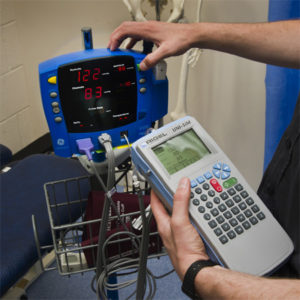
wounds, catheter or other conductive paths offer to micro shock leakage. Electrical accidents in medical environment can also result when an electric current passes through
the victim’s body unintentionally through contact with plumbing fixtures, metal bed frames or other conductive surfaces at ground potentials. The safety problems in hospitals and health care facilities is aggravated by the fact that there is a multiplicity of such electrically powered appliances frequently moved from place to place an scattered throughout the hospital premises. All equipments, directly or indirectly used for patient care, should have all exposed metal surfaces solidly grounded. IEC 601-1 recommends that for medical
equipments, the current flowing continuously through the body should not exceed 100
micro amps within a frequency range of 0 to 1KHz. In the case of abnormal situation
(ex. Equipment failure) the maximum current should be less than 500 micro amps for
frequencies up to 1KHz. Above 1 KHz this current increases proportionally with
frequency.
It is to be specially mentioned that meeting the requirements of function parameters is also
an essential part of Safety in the case of medical equipments. This is to avoid erroneous
diagnosis and failure of operation, when it may become essential for the revival of the
patient. The need of protection from external interference as well as avoiding interference
of one equipment with another equipment endangering safety, is also important.
Electrical Safety Test
Equipment which is powered by 240volt, 50Hz mains electricity can be constructed with
a protective earth (3-wire mains cable) or be of double insulated construction (2-wire mains cable). These are known respectively as Class I and Class II devices. Mains powered equipment which is double insulated (Class II) and doesn’t have a patient circuit (applied part) as a rule doesn’t need an electrical safety test and should be checked for function only.
Mains powered equipment which has a protective earth (Class I) but doesn’t have a Patient circuit (applied part) needs a basic electrical safety test and also should be checked for function.
Mains powered equipment of either Class I or II construction which has a patient circuit
(applied part) needs an electrical safety test and a function test. The Class II equipment
will only need the patient connection parameters tested. AS/NZS-3551:2004 specifies what parameters should be tested. These include:
Basic Parameters Patient Connection Parameters
Insulation Resistance Patient Lead (Applied Part) Leakage
Earth Wire Resistance Mains On Applied Parts (Mains Contact Current)
Earth Leakage Current
Note: 240volt electrical leads on medical equipment do not need to be separately tested and tagged.